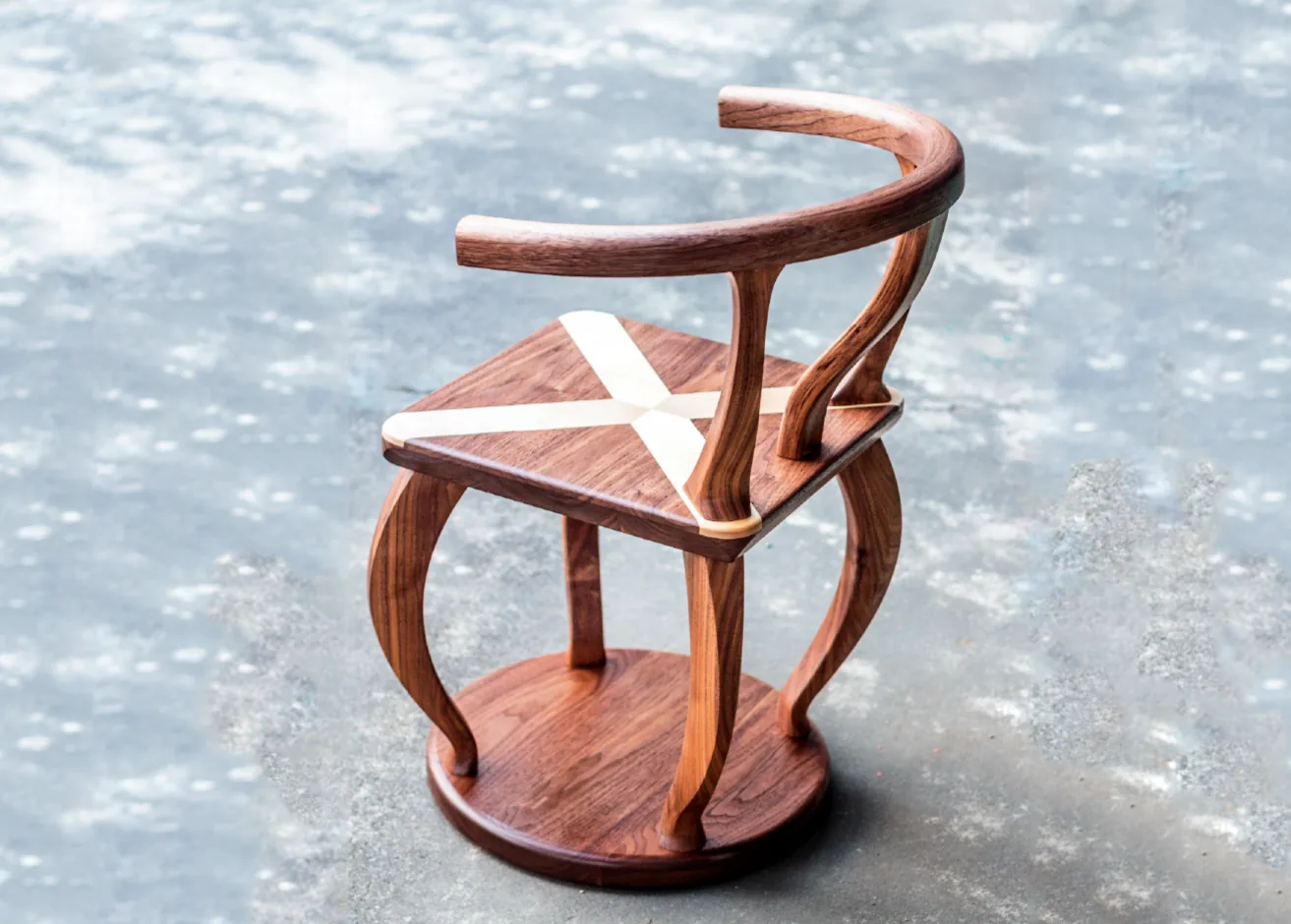
Bamileke 天圓地方
Ming-style joinery × Bamileke form
A cross-cultural chair that merges Ming round-back proportions with the Bamileke earth-spider throne. The piece expresses 'round heaven, square earth' through structure: curved arms meet a circular base and a square seat with birch inlay. Built entirely by hand in walnut, the chair was shown at Yodex in Taipei, where it tested whether two distinct furniture traditions could coexist in a single form without losing either identity.
Form studies
The design began with research into both traditions. Ming round-back chairs use continuous curves to express flow and hierarchy. Bamileke thrones use geometric, grounded forms tied to cosmological symbolism. Sketches and paper templates tested how curved armrests (representing heaven) could sit above a circular base (representing the underworld), with a square seat bridging the two. Angles were tuned repeatedly to find a balance point where the chair felt stable and the proportions read clearly.
Templates and shaping
Ten acrylic templates and six MDF molds were hand-cut with compound angles to guide the shaping. All work was done with saws, rasps, and chisels, with no CNC. Walnut was chosen for the frame because its grain is tight enough to hold fine joinery, and birch for the inlay because its lighter tone creates contrast against the walnut seat. Shaping the curved arms required repeated test fits against the templates to maintain consistent radii across both sides.
Joinery and finishing
The birch X inlay was carved into the square seat, marking the intersection of the two cultural references. Ming-style mortise-and-tenon joinery connected all structural members, with each joint hand-fitted to ensure tight tolerances. The final surface received eight hand-rubbed oil coats, building a finish that protects the wood while letting the grain texture remain tactile.
Specifications
W55 × D43 × H74 cm · hand-cut walnut with birch inlay · mortise-and-tenon joinery · 10 acrylic templates, 6 MDF molds · exhibited at Yodex, Taipei · 2018
Gallery
- Challenges1/2
Early joints failed and the base wobbled. Molds were recut and leg angles retuned to stabilize the structure. Blending two aesthetics without heaviness meant reducing ornament and letting the structure itself carry the symbolic meaning.
- Insights2/2
Template and mold precision determine joinery fit. Investing time in accurate templates early avoids rework later. The story reads clearest when structure performs the symbolism, not added decoration.
Swipe to explore