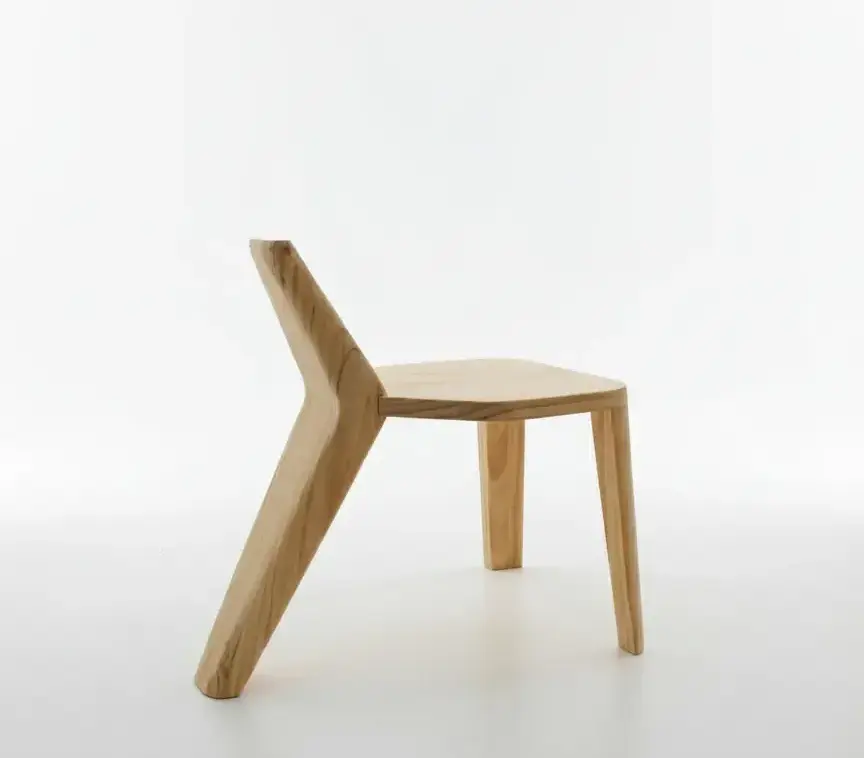
( ) Chair
Birthing-chair study in pine
Inspired by African birthing chairs seen on a South African trip, this study softens the original's angular, supportive stance into a rounded, low seat with a gentle backrest. Built in pine with dowel joinery, the aim was to keep the functional essence of a chair designed to support the body during labor while shifting the form toward something quieter and more contemporary. The parentheses in the name reference the open, cradling shape of the seat.
Sketching and references
The project started with photographs and sketches of traditional African birthing chairs, which are typically low, angled, and built for stability under shifting weight. Variants explored how much the original's angles could soften before the chair lost its functional character. The final direction set a low seat height with a gentle backward lean in the backrest, keeping the wide stance that gives the original its grounded feel.
Milling and joinery
Pine blanks were table-sawn to rough dimensions, planed flat, and then hand-rounded on all exposed edges to soften the form. Dowel joints were drilled at compound angles to achieve the splayed leg geometry, then dry-fit with clamps to check alignment before gluing. Pine is forgiving to work with but shows stress quickly at joints, so each connection was tested under load before committing to the final assembly.
Assembly and finishing
Final assembly brought all components together with glued dowel joints. After assembly, the entire piece was sanded progressively from coarse to fine grits, then stained to even out the pine's color variation. A final hand pass refined the edge radii across all surfaces, giving the chair a consistent soft feel and revealing the grain pattern through the stain.
Specifications
W40 × D38 × H45 cm · pine with hand-rounded edges · dowel joinery at compound angles · stained finish · Taichung, Taiwan · 2023
Gallery
- Challenges1/2
Early prototypes wobbled and tipped forward when weight shifted. Leg angles were adjusted and joints reinforced until the geometry held stable under load. The low seat height amplified any imbalance, making precise angles more critical than on a standard-height chair.
- Insights2/2
Pine's stress points show up quickly with rounded forms and compound angles. Testing weight distribution earlier in the process saves rework. Stable posture comes from tuned leg angles more than mass.
Swipe to explore